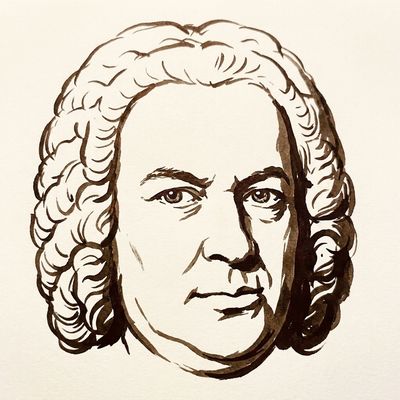
A master of counterpoint whose keyboard works remain a foundation of piano technique and study.
Johann Sebastian Bach spent his life as a working church and court musician in the German states — an organist and choirmaster who, from 1723, served as cantor of St. Thomas’s Church in Leipzig and stayed there until his death. In his own lifetime he was admired chiefly as a performer; the wider fame of his composition came only generations later. For a pianist, he is where clear thinking at the keyboard begins.
Almost all of Bach’s keyboard music was written for harpsichord, clavichord and organ — the piano was only being invented in his final years — yet it has become central to how pianists are taught. The Well-Tempered Clavier, two books of preludes and fugues in every key, the two- and three-part Inventions, and the Goldberg Variations all train the hands to hold several independent voices at once. His writing is built on counterpoint, where each finger seems to sing a line of its own.
A learner usually meets Bach early. The Prelude in C major that opens The Well-Tempered Clavier lies gently under the hands and is often among the first real pieces a student plays, while the Inventions build independence between the two hands a step at a time. Few composers reward patient, unhurried practice as directly as Bach.